
Good morning, Thread Readers.
In 2024, one Chinese state-owned company built more commercial ship tonnage than the entire American shipbuilding industry has produced since World War II (CSIS). Two U.S. Senators, both former Naval officers, have proposed a solution. The SHIPS for America Act (S. 1541), introduced by Sens. Todd Young (R-IN) and Mark Kelly (D-AZ), would rebuild the American fleet and the workforce that sails it. In the House, a similar bipartisan effort is being led by Reps. Trent Kelly (R-MS) and John Garamendi (D-CA) (H.R. 3151).
The SHIPS for America Act is both a national security and women's economic security bill. Women hold about 18 percent of shipbuilding jobs today (Data USA), and in welding, the yards' biggest trade, just 5 to 6 percent (BLS). An industry that needs a quarter million new workers cannot recruit from only half the population.
Now, let's dig in.

The Problem
About 80 U.S.-flagged ships sail in international commerce (DOT), down from roughly 1,288 in the early 1950s. We barely build their replacements, either: China, Korea, and Japan together build over 90 percent of the world's commercial tonnage, while the United States manages about 0.2 percent (CRS).
The crews are just as paltry. A government estimate puts the U.S. at least 1,839 mariners short of a full sealift mobilization (DOT), and most observers believe the gap has widened since.
For decades, federal subsidies covered the gap between U.S. and foreign building costs and kept the shipyards busy. When support ended in the 1980s, commercial construction fell and the work moved overseas, to Japan, then South Korea, and China (CRS). By 2010 U.S. shipbuilding had shrunk to a rounding error.
The Solution
The SHIPS for America Act sets out to rebuild the ships and the workforce at once. What the bill does:
For American women and their families, the workforce opportunities are real. Shipbuilding and repair paid an average of about $83,000 in 2024, 10 percent above the average private-sector job (BLS). These are jobs not requiring a four-year degree. The Department of Labor estimates the maritime sector will need 200,000 to 250,000 additional workers over the next decade (McKinsey).
The last time in history shipyards opened their gates wide, women walked through them by the tens of thousands. During World War II, women rose from 2 percent of the shipbuilding workforce to as much as a fifth (Steamship Historical Society), and at the Kaiser shipyards in Richmond, California, one of the largest in the country, a third of the 90,000 workers were women (NPS). This industry has led before: the U.S. Merchant Marine Academy was the first federal service academy to admit women, in 1974 (USMMA), two years ahead of West Point and Annapolis.
Growing Support
Support for the bill, introduced in April 2025, has grown steadily. The Senate version has 27 bipartisan cosponsors, with 139 for the House companion. Last week, a significant portion of the bill was folded into the House-passed National Defense Authorization Act as a package of maritime amendments.
Off the Hill, maritime labor unions filed a joint statement of support (USA Maritime), and the Shipbuilders Council of America endorsed the bill (AMO). The Trump administration is rallying as well, pairing an executive order on maritime revival with a Maritime Action Plan (Norton Rose Fulbright).
Facts Be Told
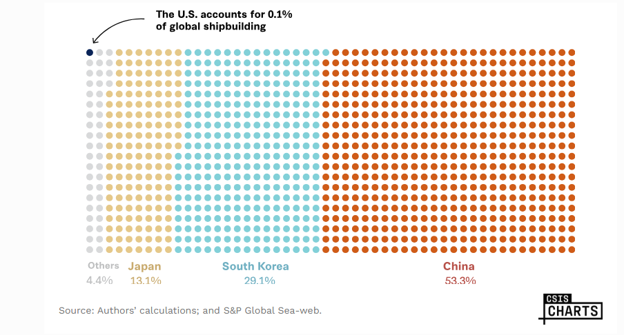
A U.S. Navy estimate reported by CSIS puts China's shipbuilding capacity at more than 230 times that of the United States, and one shipyard in Shanghai has more capacity than every American shipyard combined (CSIS).
The stakes reach well past the docks. In an overseas conflict, cargo ships typically transport 90 percent of military equipment (CRS). A country that cannot build or crew its own ships depends on someone else's fleet to supply its own forces.
Related Research
There is a lot of good research behind this one. A few of the key studies and reports, if you want to dig in:

Moving a bill this size takes patient staff work in every corner of both chambers. The following leaders have shown tremendous bipartisan spirit in their commitment to America's national and economic security:

Celebrating these lives that began on August 1st.
Francis Scott Key 1779 – 1843
Then in that hour of deliverance, my heart spoke. Does not such a country, and such defenders of their country, deserve a song?
Herman Melville 1819 – 1891
Truth uncompromisingly told will always have its ragged edges.
Jerry Garcia 1942 – 1995
If you are able to enjoy something, to devote your life to it for a reasonable amount of time and energy, it will work out for you.
Jason Momoa 1979 –
I want it to be the greatest thing I ever do: Make good humans.
The most important article you can read today is from the Engage Reader:

Women in the Skilled Trades Build America's Future
by Cindy Goff • The Engage Reader
Be kind to one another.