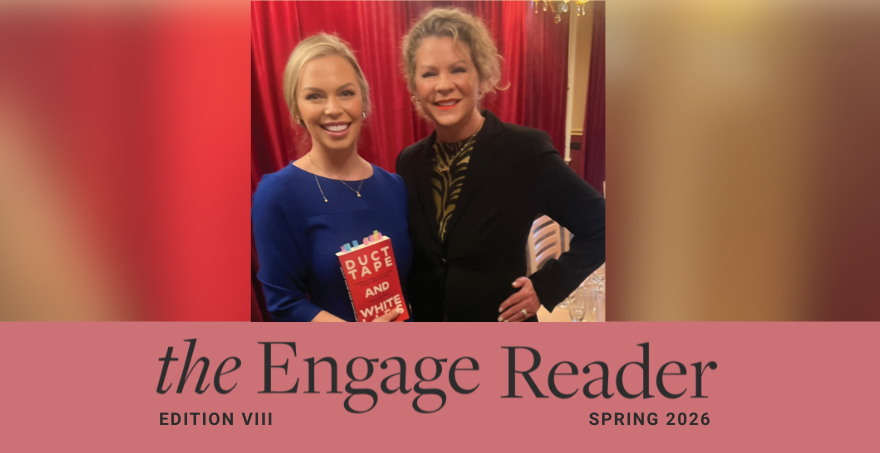
Top image: Crystal Mosser Anderson, Engage's Director of Partnership Development, with Duct Tape and White Lies author Emily Lampkin
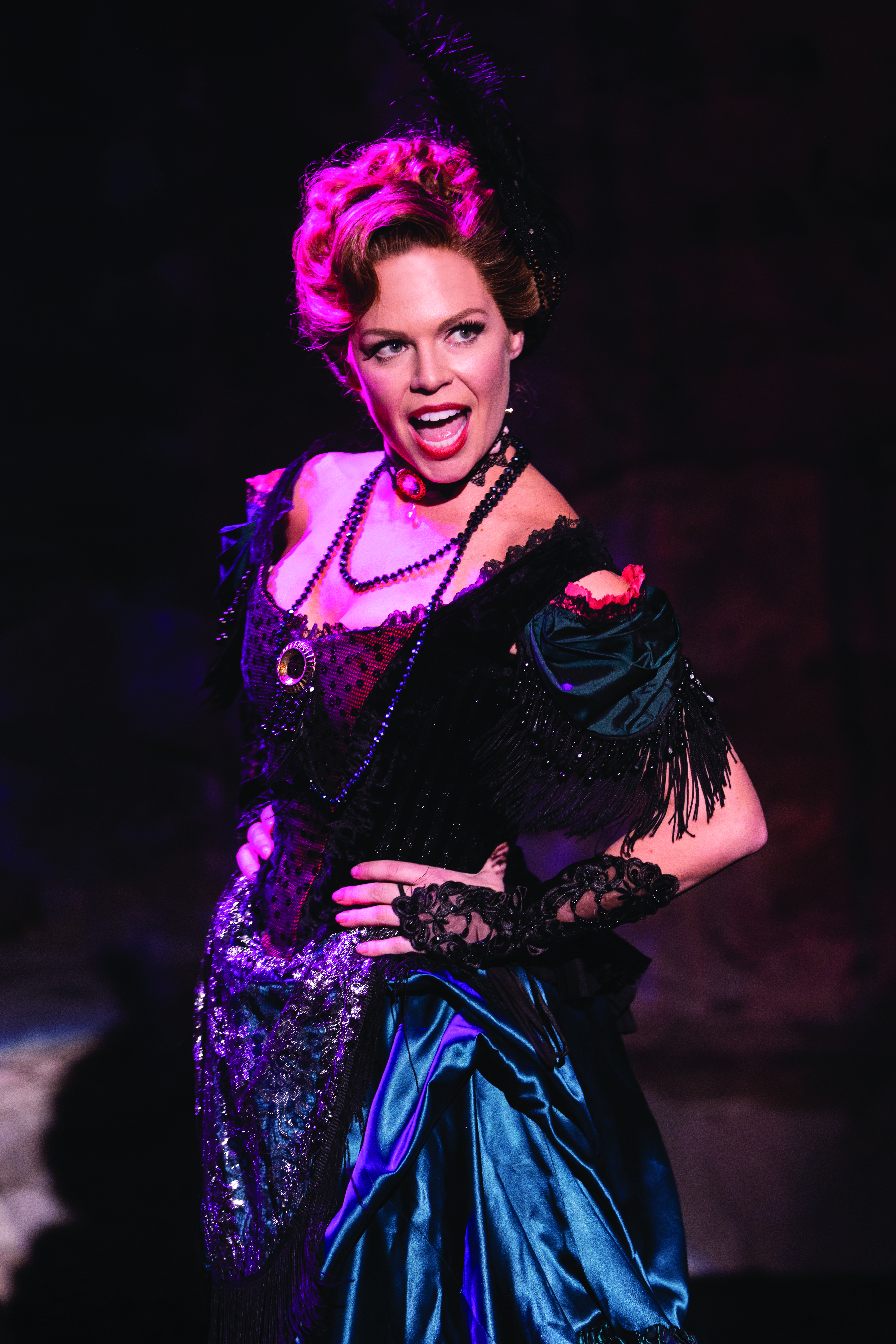
My career began on stage. The spotlight comes up. The audience hushes. I take a breath in.
In musical theater, you are trained to take up space, to project, to deliver your lines with clarity and conviction. You learn that stage presence is currency and success depends on your ability to be heard and remembered.
For me, my stage has excitingly evolved.
Now my stage is conference rooms, partnership meetings, and high-stakes conversations. This time no one hands me a script or tells me when to enter, and no one is there to remind me that my voice deserves to carry.
Somewhere in that transition, many women, myself included, start to shrink. The shift is subtle rather than dramatic. We soften our delivery, wait a beat too long and we relentlessly polish before we present. We tell ourselves we are preparing when we're actually hesitating.
And yet, as Melinda French Gates has said, "A woman with a voice is, by definition, a strong woman." I didn't lose my voice when I left the theater. I had to learn to use it in a different room.
Reading Duct Tape and White Lies felt less like reading a book and more like sitting across from the kind of friend who tells you the truth - with a wink and zero apology.
Duct Tape and White Lies by Emily Lampkin isn't polished in the way traditional leadership books try to be. It's sharper than that - more honest and more useful. It meets you exactly where you are - and then gently (and sometimes not-so-gently), calls you forward.
"It meets you exactly where you are - and then gently (and sometimes not-so-gently), calls you forward."
One line that stopped me cold: "I was the expert I was looking for."
Not because the line was surprising but because it feels undeniable. So many of us are waiting for validation, to earn credentials or for someone to confirm we are ready. And in that waiting, we outsource our authority.
Emily hands it back.
If there is a quiet epidemic among ambitious women, it is this: we mistake perfection for preparedness. We refine, we edit, we rehearse, and we delay.
Two of the simplest, most powerful takeaways from this book are also the most confronting:
'Quit waiting for perfect' and 'Everything you need to know is on the other side of action.'
Looking back on my own career, from pounding the pavement in New York City to building partnerships and revenue engines, I can trace every meaningful piece of growth not to certainty but to movement. Clarity, it turns out, is a byproduct of motion.
"Clarity, it turns out, is a byproduct of motion."
Emily mentions that everyone needs a swimsuit friend (ya know, the kind of friend you take with you swimsuit shopping, who will always tell you the truth). Throughout the book, it became clear that Emily is exactly the swimsuit friend that everyone needs in their back pocket.
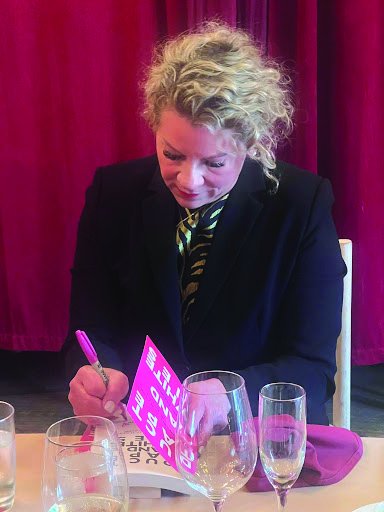
There are so many lessons in this book that I will carry with me, but in the interest of space, I'll highlight my favorite three.
Building community - whether in business, personal or even in theater - always comes back to one thing: connection. Emily breaks it down simply: it's not about grand gestures or perfectly crafted networking moments. It's the small, human openings:
"I'd like to learn more about that." "How did you get good at that?" And perhaps my favorite, "I'd like to be your friend."
They almost feel too simple to work, even a little vulnerable. And that's exactly why they do.
Even in reading the book, when Emily casually says, we're all friends now, I felt it. That small shift, from distance to connection, lands.
One of my favorite stories in the book involves a hotel check-in. Emily asks for an upgrade and she's told no. And then - she does nothing. She stands there, quietly and confidently for about fifteen seconds of silence. The answer changes.
It's a masterclass in something we rarely talk about: presence as leverage. In theater, we are taught that the pause can be more powerful than the line itself. That tension, held intentionally, draws the audience in. The same is true in business. Sometimes the most commanding thing you can do is stay exactly where you are - and let the room meet you there.
Emily calls mistakes "now I knows." After studying what makes women successful, she found a common thread: they don't dwell in regret. They take risks, and when things don't go as planned, they turn those moments into lessons.
In theater, there's a simple rule: the show must go on. And in many ways, that's the lesson here. Confidence isn't built on getting everything right. It's built on moving, learning and continuing anyway.
Today I lead partnership development at Engage, where we are working to make economic security for women and their families the defining movement of the 21st century.
And here is what becomes clear: this work is about voice as much as policy. It is about whether women feel equipped to ask, to negotiate, to lead, to stay in the room when it matters most.
Emily writes, "Women leaders are the single most underused resource in the world and our time is now." She's right.
When women step fully into their authority, not performatively but authentically, the impact extends far beyond the individual.
I never really left the stage. I've evolved. I no longer wait to be cast or for the cue. Perhaps most importantly, I no longer confuse uncertainty with incapability. Because, for me, the truth that lingers long after the final page of Duct Tape and White Lies is this: You are not waiting to become the expert. You are the expert you've been waiting for.
Crystal Mosser Anderson is Engage's Director of Partnership Development. She joined the team in January.