
Good Morning Thread Readers,
Noah Wylie is back in Season 2 of The Pitt, and the crisis he navigates on screen is anything but fiction. Anyone who has spent time in an emergency room knows it firsthand: too few beds, too long a wait, and a system stretched past its limits.A bipartisan group of lawmakers is pushing to change that.
The Addressing Boarding and Crowding in Emergency Departments Act (ABC-ED Act), introduced by Senator Chris Coons (D-DE), Senator Dave McCormick (R-PA), Representative John Joyce (R-PA), and Representative Debbie Dingell (D-MI), would take direct aim at the bed shortage overwhelming emergency rooms across the country.
At Engage HQ, we are heartened to highlight legislation which, as is stated later, “works within existing federal grant programs rather than creating new spending.” Also standing out are AI powered tools solving problems at the most basic human level – sickness and health, life and death. For non–technically minded Americans who harbor fears about AI, noble uses of this technology go a long way.
Let's dig in.

America's hospitals are stretched thin. The numbers tell the story.
In 1975, there were 1.5 million hospital beds in the United States — one for every 143 people. Today, that number has dropped to 900,000 beds, or one for every 390 people. (NYU Stern) It’s a clear reason emergency rooms across the country are overwhelmed. The consequences are serious.
Here are the hospitals and medical centers that are innovating, and the results are striking.
Baptist Medical Center in Little Rock, Arkansas's largest hospital, faced chronic overcrowding, ambulance diversions, and boarding backlogs. Using AI-powered tools to manage hospital beds, they achieved 40% faster discharge processing and reduced the number of patients boarding in the ER by hundreds each month. The tools predict which patients could be discharged and alert staff when capacity is approaching its limit.
Sarasota Memorial Hospital in Florida deployed an AI platform that forecasts patient discharges hours in advance, allowing care teams to coordinate beds, transport, and case management proactively rather than scrambling reactively. The result: a 32% drop in ED boarding hours, even as patient volume grew by 22%.
The technology behind these results is not experimental. It is already working. Rather than waiting for a physician to formally order a discharge before mobilizing staff, AI tools analyze clinical notes, lab results, and historical patterns to identify which patients are ready to go home hours earlier in the day. Beds free up faster. The ER unclogs. The cascade that The Pitt dramatizes every week slows down in real life.
What is missing is the infrastructure to scale it. That is exactly what the bipartisan ABC-ED Act aims to fix, working within existing federal grant programs rather than creating new spending, a practical approach in a cost-conscious Congress.
The Addressing Boarding and Crowding in Emergency Departments Act (ABC-ED Act)
Introduced by Senators Chris Coons (D-DE) and Dave McCormick (R-PA) and Representatives John Joyce (R-PA) and Debbie Dingell (D-MI).
Co-sponsored in the Senate by Senators Lisa Blunt Rochester (D-DE), Thom Tillis (R-NC), Angus King (I-ME), and Markwayne Mullin (R-OK).
Co-sponsored in the House by Representatives Ritchie Torres (D-NY), Mark Amodei (R-NV), Deborah Ross (D-NC), Rashida Tlaib (D-MI), Sarah McBride (D-DE), Jason Crow (D-CO), Doris Matsui (D-CA), Jake Auchincloss (D-MA), Buddy Carter (R-GA), Donald Davis (D-NC), Eugene Vindman (D-VA), Jay Obernolte (R-CA), Joe Neguse (D-CO), and Darren Soto (D-FL)
The bill would:
• Expand federal grant funding to develop state- or region-wide, real-time tracking systems for hospital bed availability, with data published on a publicly accessible dashboard
• Create a new pilot program through the Centers for Medicare and Medicaid Services (CMS) Innovation Center to improve care for those most likely to experience ED boarding, including seniors
• Direct the Government Accountability Office (GAO) to develop and disseminate best practices for public health data tracking nationwide
"If you've ever had to go to an emergency room in Delaware, you know that wait times are just too long. Too many patients end up having to wait hours, or even days, for a bed to open up in the hospital, no matter the emergency. I've heard from so many Delawareans about this problem, and I'm proud to lead the federal effort to find solutions. I urge our colleagues to take up this bipartisan bill that will help hospitals modernize their systems, take stress off emergency rooms, and ensure more Americans are getting the care they need as soon as possible."
— Sen. Chris Coons (D-DE)
"Advanced technology and AI are re-shaping the way our country and economy work. It's critical to Americans' long-term health and wellbeing that our nation's hospitals can access technological resources to update their procedures and practices and ensure patients are receiving the care they need in a timely fashion. I'm grateful to work across the aisle with Senator Coons to help improve the quality and efficiency of our nation's healthcare system."
— Sen. Dave McCormick (R-PA)
"Throughout the country, American patients cannot receive the care they need due to the lack of open hospital beds and long wait times, which have only increased due to the physician shortage. By allowing the use of public health data modernization grants to create systems that track hospital capacity, this data will allow us to identify and implement solutions that will lower wait times for American patients."
— Rep. John Joyce, M.D. (R-PA)
"Too many people have died waiting for a spot in the emergency room while beds sat empty at a hospital down the street. This legislation will empower public health departments to implement advanced preparedness and response technology to ensure patients make it to the facilities where they can receive timely and adequate care."
— Rep. Debbie Dingell (D-MI)
Facts Be Told
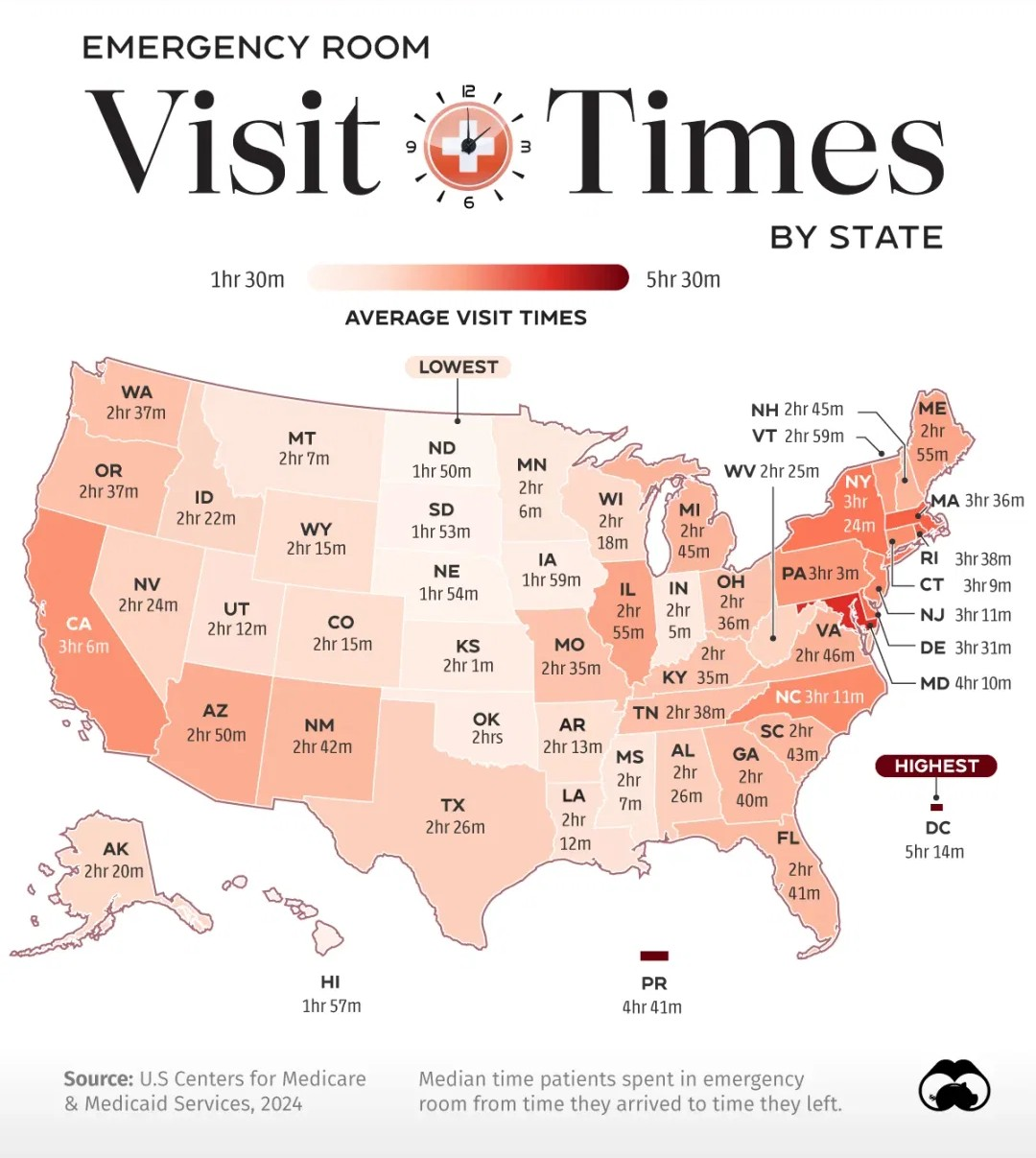
Average ER visit times range from under two hours in North Dakota to over five hours in Washington, D.C. In states like Maryland, New York, and Pennsylvania, patients are waiting well over three hours just to be seen and sent home.

The following champions have demonstrated bipartisan spirit, a commitment to women and families, or simply inspired us with their grace and generosity.

🌷🐣🌸
Spring Riddle
What can you find in the middle of March and April, but not at the beginning of either month?
🌼🦋🌿
Answer: The letter R
Be kind to one another.