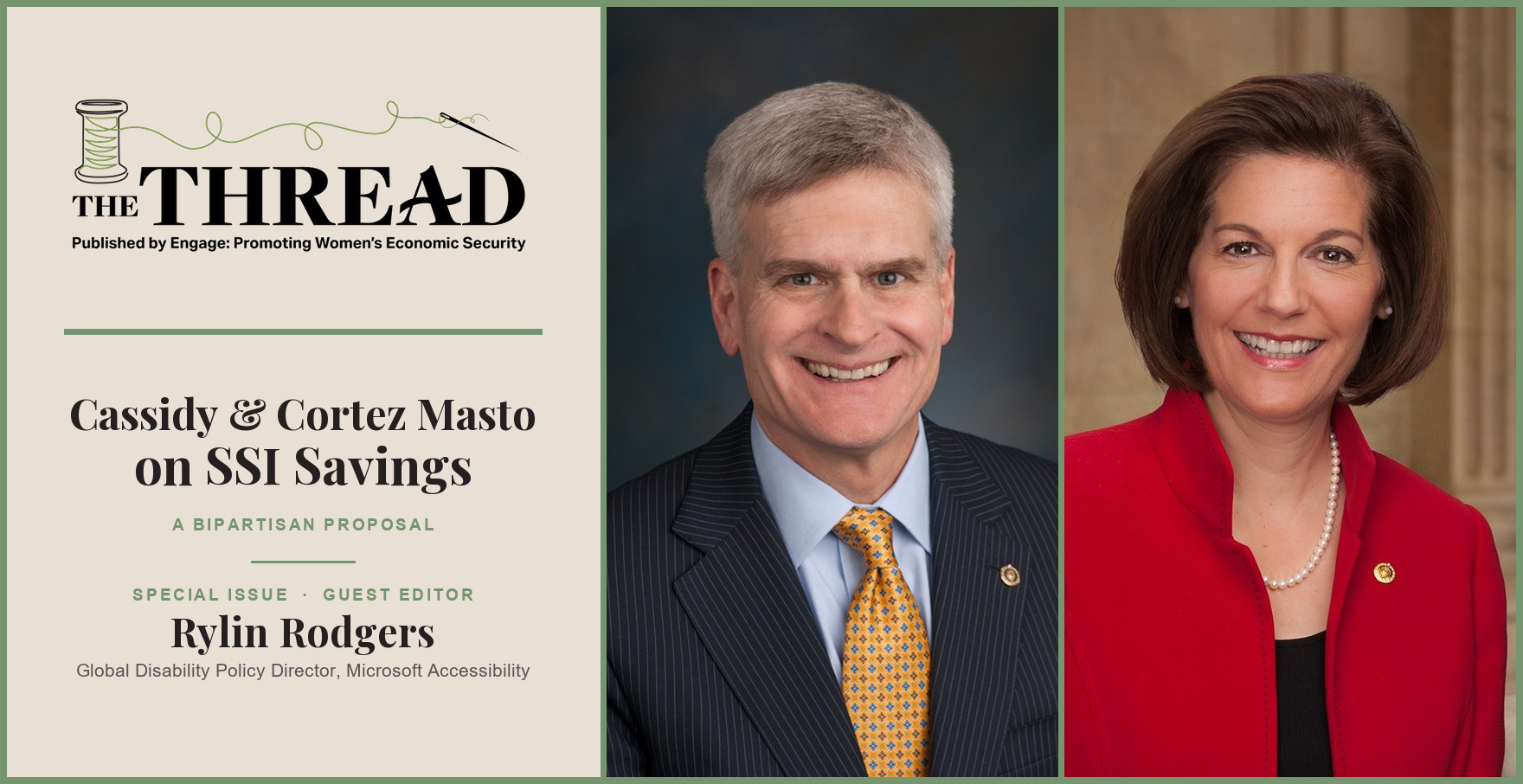
SPECIAL ISSUE
Guest Editor: Rylin Rodgers
Global Disability Policy Director, Microsoft Accessibility
Engage HQ is excited to introduce the guest editor for this special issue, Rylin Rodgers. We will let her introduce herself below. Engage is fortunate to have Rylin and Microsoft as partners in our work on disability issues.
For decades, Washington has debated how to modernize disability policy, yet one of the most significant barriers to economic opportunity remains largely unchanged: the Supplemental Security Income (SSI) asset limits.
As Microsoft's Global Director of Disability Policy, I see firsthand how outdated policies can limit employment, financial security, and economic participation. Today, SSI recipients can have no more than $2,000 in savings, while married couples are limited to $3,000, thresholds that have remained essentially unchanged since 1989.
The result is that many people are forced to choose between building financial stability and maintaining the supports they need to live and work.
That is why I'm excited to bring the SSI Savings Penalty Elimination Act (S. 1234 / H.R. 2540), a bipartisan bill sponsored by Senators Catherine Cortez Masto (D-NV) and Bill Cassidy (R-LA) and Representatives Brian Fitzpatrick (R-PA) and Danny K. Davis (D-IL), which would modernize these limits and give disabled Americans greater opportunity to save, work, and plan for the future.
At a time when employers across industries are searching for talent, this is not simply disability policy. It is sound economic policy.
Let's dig in.
— Rylin Rodgers, Global Disability Policy Director, Microsoft Accessibility

The Problem
Supplemental Security Income provides modest support to disabled people and older adults with very limited income and resources. The asset test that governs it is frozen in another era. A car repair, a rental deposit, a medical bill, or an assistive technology purchase can consume most or all of the savings a recipient is permitted to hold, and going a dollar over ends the benefit.
The rule does more than make emergencies harder. It discourages people from taking additional hours, accepting a promotion, or building any cushion at all, because the cushion itself is disqualifying. Couples carry a second penalty on top of the first. Two single recipients may hold $2,000 each, but the same two people may hold only $3,000 between them once they marry, which is a quarter of their savings gone on the wedding day (The Arc).
About 7.3 million Americans receive SSI, and a majority of them, 52 percent, are women (SSA). More than a million of the total are disabled children.
The Solution
Senators Cortez Masto and Cassidy introduced the Senate bill on April 1, 2025, with Senate Finance Committee Ranking Member Ron Wyden (D-OR) as the third lead. Seven more senators signed the same day, alternating party by party: Sens. Susan Collins (R-ME), Maggie Hassan (D-NH), James Lankford (R-OK), Patty Murray (D-WA), Lisa Murkowski (R-AK), Sheldon Whitehouse (D-RI) and Rick Scott (R-FL). Representatives Fitzpatrick (R-PA) and Davis (D-IL) filed the House companion the same day.
IMPORTANT: The bill does not create a program, does not change who qualifies for SSI, and does not touch the benefit amount. It moves one number.
What the bill does:
The reform changes an eligibility threshold, not the structure of SSI. It gives recipients room to keep an emergency fund, to plan ahead, and to take on work without the raise putting the rest of their support at risk.
“Outdated rules are making disabled Americans pick between a better job and losing their safety net. That’s wrong. Instead, let’s encourage work, help people save, and lift them out of poverty.”
— Senator Bill Cassidy (R-LA)
“A $2,000 rainy-day fund doesn’t go as far as it did in 1989, but that’s all the savings that people who rely on SSI benefits are allowed. We shouldn’t punish people who are working hard, saving their money, and planning for the future. Congress must raise the SSI asset limit to help our seniors and Americans with disabilities.”
— Senator Catherine Cortez Masto (D-NV)
“For over forty years, outdated restrictions have discouraged work and penalized those who try to save for their future. The SSI Savings Penalty Elimination Act modernizes these limits, ties them to inflation, and ensures that seniors and individuals with disabilities are not forced to choose between earning a paycheck and keeping the benefits they depend on.”
— Representative Brian Fitzpatrick (R-PA)
Why It Matters
For workers, an outdated asset limit is a benefits cliff. Earning more or banking part of a paycheck can put critical support at risk before a person has enough stability to absorb the loss, which makes advancement at work feel financially dangerous rather than rewarding.
For employers, the same rule complicates hiring, retaining, and promoting disabled talent. Raising the limit makes it easier for workers to accept opportunities, to use the financial wellness programs their employers already offer, and to build the resilience that keeps people in a job.
For families, the change is more basic than either. It makes room for an emergency fund and it ends a rule that penalizes marriage. Policy should encourage work, savings, and family stability rather than make all three harder to reach.
“JPMorganChase, like many companies, wants to attract and retain the very best qualified people of all abilities. We applaud the bipartisan reintroduction of the SSI Savings Penalty Elimination Act, which would make common sense updates to the outdated rules for SSI benefits to reflect current economic conditions and keep pace with inflation.”
— Bryan Gill, Global Head of the Office of Disability Affairs, JPMorganChase
Growing Support
The Senate bill now carries 17 cosponsors, nine Republicans, seven Democrats, and one Independent, which puts 18 senators on it once Senator Cortez Masto is counted. The House companion carries 37, and 19 of those are Republicans, so the Democrats need to catch up.
ON THE BILL
Senate · S. 1234
House · H.R. 2540
Off the Hill, more than 200 businesses, faith groups and organizations have endorsed the bill, a list that runs from AARP, Justice in Aging and The Arc to the U.S. Chamber of Commerce, Microsoft, the National Association of Evangelicals, the United States Conference of Catholic Bishops and Bipartisan Policy Center Action. National polling reported by the National Academy of Social Insurance found that about two thirds of Americans support limits of at least $10,000 for an individual and $20,000 for a couple.
The Senate bill sits with the Finance Committee and the House bill with Ways and Means. Neither committee has acted on it.
Facts Be Told
We say it every issue, and the savings penalty is a clean case. This is a women's economic security issue. Women are the majority of the people this rule governs, at 52 percent of SSI recipients (SSA), and they are the majority again among the older recipients who reach SSI after a working life of lower pay and time out for caregiving. A rule that punishes saving falls hardest on the people with the least room to save in the first place, and a marriage penalty that erases a quarter of a couple's allowable savings is not a technicality to a household living on an SSI check.


The following leaders have shown tremendous bipartisan spirit and commitment to disabled Americans and their families.

Engage at work this week. On September 16, the Senate Aging Committee held the first congressional hearing ever devoted to menopause, led by Chairman Rick Scott (R-FL) and Ranking Member Kirsten Gillibrand (D-NY). An hour before the gavel, Engage's Menopause and Longevity Working Group gathered on Capitol Hill, then walked over together to fill the hearing room. A few pictures from the afternoon are below.

Be kind to one another.