Good morning, Thread Readers,
This week, Vice President Vance floated a childcare idea that motivated left and right thought leaders to pen op-eds with great dispatch. After a quick and unscientific search, it’s safe to say enthusiastic support was hard to find. So, here is some good bipartisan news to kick off your day and hopefully inspire your immediate co-sponsorship if you are a Member of Congress.
The law that pays for child care assistance in every state was written in 2014 and has not been updated since. Sens. Deb Fischer (R-NE) and Kirsten Gillibrand (D-NY), joined by Sens. Susan Collins (R-ME) and John Hickenlooper (D-CO), have the fix. Their Child Care Modernization Act (S. 2828) updates the Child Care and Development Block Grant, the program that helps about 1.6 million children a month get to a licensed provider while their parents work (HHS). The House followed in June, when Reps. Ryan Mackenzie (R-PA) and Kristen McDonald Rivet (D-MI) filed the companion (H.R. 9224).
And on the fiscally responsible measuring stick, nothing in this legislation creates a new agency or attaches a dollar figure. It updates an existing law, making the money already flowing work better for all Americans.
Let’s dig in.

The Problem
A year of child care in America averaged $13,184 in 2025, about a tenth of a two-parent household’s income and a third of a single parent’s (Child Care Aware of America). Putting two children in a center now costs more than median rent in every state with data. Day care prices have climbed 30 percent since the end of 2019 and have outrun overall inflation every year since 2022 (BLS). Parents who pay for care spend a median $250 a week, more than half of what they pay for housing (Federal Reserve).
Unfortunately, the price is only half of it. Nationwide there are about 10.8 million licensed slots for 14.8 million children who may need one, and the gap runs widest in rural counties (Bipartisan Policy Center). Home-based providers, the option most rural families rely on, have been disappearing for two decades. More than 97,000 licensed family child care homes closed between 2005 and 2017 (HHS), and in Minnesota and North Dakota the count has fallen by more than a fifth since 2019 (Minneapolis Fed).
The Child Care and Development Block Grant has not kept pace. Each year the block grant sends about $8.8 billion to states and tribes (CRS) and reaches roughly one in six of the children eligible under federal rules (HHS). Its authorization ran out after 2020. Congress has authorized the funds each year since, but the rules still date to 2014. Most states set what they pay providers from a survey of what parents already pay, and most pay below the federal benchmark (HHS), so a provider who takes subsidized children is often paid less than it costs to keep the room open. A 2024 regulation had capped family copayments at 7 percent of income and paid providers on enrollment rather than daily attendance, and it was rescinded this July (HHS).
The Solution
Senators Fischer and Gillibrand introduced the bill last September with Senators Collins and Hickenlooper as co-leads, building on a bill Senator Fischer first filed in 2024.
IMPORTANT: Nothing in it creates a new agency or sets a specific funding level. The bill rewrites the 2014 law so the money already flowing works better.
What the bill does:
The House text is largely the same bill, with implementation deadlines moved one year later.
“Millions of American families are receiving child care under extremely outdated federal policies, but we have a solution to fix it. This bipartisan legislation not only reauthorizes the CCDBG, but modernizes the program to meet the challenges we have today. I am proud of the work we’ve done on this bill, and I look forward to getting it across the finish line.”
— Senator Deb Fischer (R-NE)
“Working parents should never have to choose between keeping their jobs and finding safe, affordable care for their children. Reauthorizing and strengthening the Child Care and Development Block Grant is the single most practical step Congress can take today to lower costs for parents, support childcare workers, and expand access in underserved communities. The Child Care Modernization Act is the right step in the direction of investing in our families, children, and economy and I will continue to work with my colleagues to ensure childcare is affordable and attainable for all.”
— Senator Kirsten Gillibrand (D-NY)
Growing Support
Eight senators are currently on the Senate bill, four from each party: Deb Fischer (R-NE), Susan Collins (R-ME), Katie Britt (R-AL), Pete Ricketts (R-NE), Kirsten Gillibrand (D-NY), John Hickenlooper (D-CO), Mark Kelly (D-AZ), and John Fetterman (D-PA). The House companion has nine, led by Representatives Mackenzie and McDonald Rivet with Reps. Ashley Hinson (R-IA) and Susie Lee (D-NV), and joined since June by Reps. Brian Fitzpatrick (R-PA), Salud Carbajal (D-CA), Zoe Lofgren (D-CA), Rob Wittman (R-VA) and Joseph Morelle (D-NY).
We featured Senator Britt’s childcare package with Sen. Tim Kaine (D-VA) last spring. Senators Collins and Gillibrand were co-sponsors on that legislation as well.
Facts Be Told
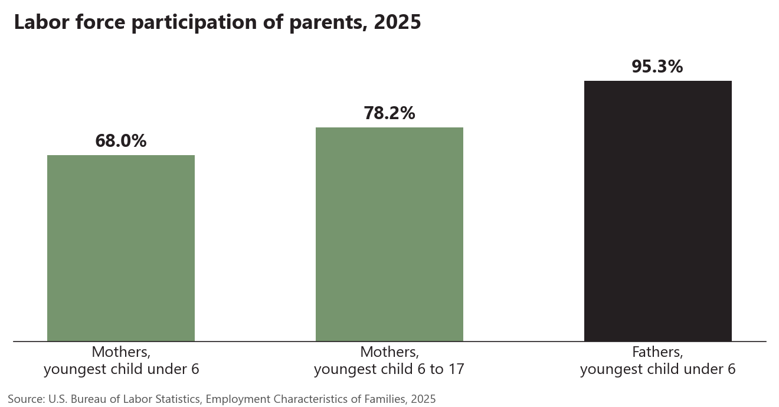
Sixty-eight percent of mothers with children under 6 are in the labor force, against 95 percent of fathers (BLS). Among mothers of young children who are not working, four in ten say child care is part of the reason (Federal Reserve). When a child care problem keeps a parent home, the household loses about 66 work days a year on average, and families below the poverty line lose more than 100 (Census Bureau).

Progress moves one cosponsor and one hearing at a time, and it takes diligent staff to keep asking. The following leaders have shown tremendous bipartisan spirit in their commitment to women and working families:

Women outnumber, outvote, and outlive men™, so it is heartening that the Senate Special Committee on Aging will hold the first-ever hearing on menopause this Wednesday, September 16, at 3:30 p.m. in SH-216. The hearing is titled Half the Country, Zero Hearings: Meeting the Moment to End the Menopause Care Gap in America.
Taking center stage will be:
Jean Wactawski-Wende, PhD
Dean and SUNY Distinguished Professor
School of Public Health and Health Professions, University at Buffalo
Buffalo, NY
Lynne M. Coslett-Charlton, MD, MSCP, FACOG
Gynecologist
American College of Obstetricians and Gynecologists
Pittston, PA
Jennifer Weiss-Wolf, JD
Executive Director
Birnbaum Women’s Leadership Center at NYU Law
New York, NY
Suzanne Silverman Fenske, MD, FACOG, ABOIM, MSCP
Double Board-Certified Gynecologist
Founder, TaraMD
Women’s Health Ambassador, HHS Office on Women’s Health
New York, NY
Three cheers to Chairman Rick Scott and Ranking Member Kirsten Gillibrand for this historic convening.
Be kind to one another.