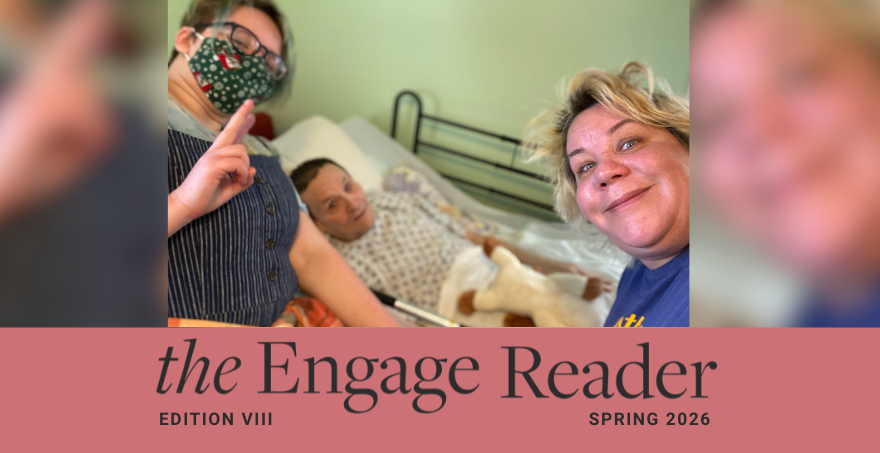
It had been twenty-three days since I had seen my father, and I knew it. I had not marked it on a calendar. I just knew. The guilt hummed in the background while I bought groceries, walked the dog, answered emails, tried to build a freelance business, and parented a child who needed steadiness every day. Ordinary life was already loud enough. The guilt ran underneath it like a second soundtrack.
Then nighttime made everything louder.
At one in the morning, eldercare did not look like policy or infrastructure. It looked like medicated toothpaste I still had not picked up. It looked like BOOST I needed to order. It looked like a conversation with the staff at my father’s assisted living facility about whether the better incontinence supplies were really worth the extra money.
My father’s pension and Social Security covered most of his care. Most is a fragile word.
Most still left me staring at the monthly bill for his room and constant care. Most still left me paying for all the things that seemed too small to count until they absolutely did. Most still left me awake doing math about what would happen when he needed more help: a wheelchair, a hospital bed, a different room, the final expenses of a man with no life insurance when I was already flinching at the cost of keeping him comfortable now.
This is one of the quietest lies we tell about care: that its price is easy to see.
The hidden price of caring for my father came in two forms. First, the financial burdens that never looked large enough to deserve a name until they started piling up. Second, the invisible labor: the time, attention, planning, vigilance, and emotional steadiness that women are so often expected to provide as if it were simply part of our personality.
That second category was harder to name, and much harder to measure.

What I was carrying with my father did not look, at first glance, like economics. It looked like guilt. It looked like avoidance. It looked like resentment, followed quickly by guilt about resentment. It looked like knowing there was a ten-mile drive standing between me and the man who had once been my father in full color, and still putting off the trip as if procrastination itself might spare me something.
I was avoiding him.
There is no elegant way to say that, so I may as well say it plainly. Seeing him was hard. The visits required a kind of emotional steel I did not always have on hand. Dementia is a slow demolition, and there is something uniquely exhausting about having to keep making conversation in the rubble.
I would have rather watched paint dry. I would have rather scrubbed the toilet. I would have rather done my taxes with an abacus.
This is not because my father became cruel. In some ways, I was lucky. Dementia did not make him mean. He was still affable. He still knew who I was. He could still make out his granddaughter and son-in-law in the shadows. There are families who endure far more frightening versions of this disease, and I know that.
But luck has its own toll. And I kept getting stuck with the bill— for nine grueling and relentless years.
Maybe it cost so much because our story had never been simple.
When people picture a daughter caring for her father, there is usually an unspoken script underneath it: he cared for her all her life, and now it is her turn. There is tenderness in that story, and a moral neatness people find comforting. But that is not the only story. There are also fathers who were absent, problematic, or unavailable. Fathers with daughters who are still expected to absorb the labor of care as if a lifetime of paternal devotion had always been there in the first place.
My father was absent for most of my childhood. We found each other again only as adults, and when we did, I got to know not just a father, but a singular person: curious, brilliant, funny, deeply engaged with the world, and, maybe most meaningfully to me, interested in me. He became my biggest cheerleader, the person most invested in my work and the texture of my life.
“And because women are so often trained into fluency in this kind of invisible labor, the burden can disappear even as we are carrying it.”
That made what came next both beautiful and charged.
I was grateful for the father I got back, and resentful that I was being asked to rearrange my life for a man who had not rearranged his for me when I was a child. So when dementia began taking him apart, I was not only losing a parent. I was losing a witness.
And because life has a sick sense of humor, I was also the one buying the diapers.
That, to me, is the silent economy of care.
It had two layers. The first was the steady drip of financial burdens that never looked important enough to count until they did. The toothpaste. The BOOST. The better supplies. The dental work. The extra things that made him more comfortable and more dignified. None of it felt enormous on its own. Together, it became its own kind of bill.
The second was harder to price and easier to hide. The administrative labor. The follow-ups. The mental inventory. The budgeting. The anticipatory dread. Each tiny necessity arrived wearing the costume of a minor errand while quietly demanding more time, energy, and emotional bandwidth than I had available.
And because women are so often trained into fluency in this kind of invisible labor, the burden can disappear even as we are carrying it. We absorb. We coordinate. We remember what is running low. We compare the better option with the cheaper option. We act calm on the phone. We continue to work, parent, answer emails, buy groceries, keep appointments, and tell everyone we are fine.
That is one reason care remains so poorly understood as an economic issue. Its costs do not always arrive dramatically enough to trigger alarm. They arrive in increments: a hundred tasks, a thousand calculations, one more thing to remember, one more expense to absorb, one more call to make before the end of the day.
“Its costs do not always arrive dramatically enough to trigger alarm.”
When care is treated as a private matter, its costs do not disappear. They are simply transferred — into households, into women’s schedules, into their savings, into their sleep, into their ability to focus on work or plan for their own future.
That transfer is quiet. It is also ruthless.
Caregiving drained my budget, yes. But the larger theft was not always financial in the strict sense. It was time. Attention. Sleep. Focus. Patience. My availability to my own life.
It made the future feel expensive in ways that had nothing to do with ambition and everything to do with decline. It inserted a running tab into the back of my mind: for wipes, for dental work, for the next level of care, for the equipment that might be needed later, for the final services no daughter wants to price out before she has to.
And because so much of this unfolded in drips rather than crashes, it became very easy to minimize. I did not think of myself as someone navigating an economic problem. I thought of myself as someone trying to keep up. Someone trying not to be a bad daughter. Someone trying to keep ordinary life moving while also stewarding the slow disappearance of a man I had already once lost.
That is part of why the burden stays so invisible. Love is expected to cover the gap.
Sometimes it does. Sometimes it covers the gap for a while.
But it is not free.
And it is especially not free when the person you are caring for is someone you had to wait half your life to know. That part complicates everything. Caring for my father in the final stretch of his life was not a tidy expression of dutiful daughterhood. It was love, yes. It was also grief, anger, tenderness, fatigue, gratitude, dread, resentment, and the occasional desire to bolt.
All of those things were true at once.
My father lived ten miles away from me, and sometimes even that felt impossibly far. The real distance was not geographic. It was the distance between the man who had once been able to meet me in language, curiosity, and affection, and the man I now had to steel myself to visit.
That distance required more than anyone looking in from the outside could easily count.
That is the silent cost.
There were the small financial burdens. And then there was everything else: the time, the invisible labor, the vigilance, the unfairness of being expected to absorb it all with competence and grace, even when the story between father and daughter was never neat to begin with.

I loved my father. I avoided my father. I worried about him. I dreaded seeing him. I bought what he needed. I did the math. I tried to show up with dignity even when I felt frayed and frightened. All of those things were true at once.
Care is rarely pure. It is often loving and ugly at the same time.
But it is work. It takes from the people providing it. And when that work is left to be managed quietly, privately, and mostly by women, the cost does not vanish. It simply becomes harder to see.
It is not free. It never was.
Rebecca Gunter is a writer and cultural observer exploring language, self-authorship, and public expression. Her work names what others feel but haven’t yet said — with warmth, wit, and precision.