The United States has a workforce shortage of skilled labor where training programs like apprenticeships could make a vital difference.
A bipartisan pair of senators wants to expand apprenticeship training to create more opportunities for American workers. The American Apprenticeship Act (S. 531), introduced by Senator Amy Klobuchar (D-MN) and Senator Susan Collins (R-ME), would give states the tools and funding to expand registered apprenticeship programs by lowering the cost barriers that keep too many workers, and especially too many women, on the sidelines of one of the most effective workforce models we have.
At Engage HQ, we are working vigorously on the State of the Majority Summit, taking place on June 3rd at the Milken Center for Advancing the American Dream in Washington, DC. The Summit will feature two panels dedicated to women in the skilled trades. Please join us.
Now, let's dig in.

America has a workforce problem with millions of job openings that are currently unfilled. One of the biggest challenges for employers is finding skilled workers.
Today, roughly 680,000 Americans are enrolled in registered apprenticeships, programs that pay participants while they train and lead to industry-recognized credentials. That may sound substantial, until you compare: apprentices represent less than 1% of the U.S. workforce. In Germany, that share is 3.7%. In Switzerland, 4.3%. That’s a lot of workers — and wages — left on the sidelines.
The numbers make the case:
For women, the gap is especially stark: Despite increased participation over the past decade, women make up only 14% of registered apprentices. That rate is higher in the military, where 22% of apprenticeships are held by women (IWPR).The States with the highest share of women apprentices are West Virginia (36%) and South Carolina (35%). Delaware and Oklahoma were among the lowest at 3%. (IWPR)Bipartisan SolutionIntroduced by Senators Amy Klobuchar (D-MN) and Susan Collins (R-ME), the American Apprenticeship Act (S. 531) is before the Senate Health, Education, Labor and Pensions (HELP) Committee. A similar House companion, H.R. 1783, was introduced by Rep. Rosa DeLauro (D-CT) on March 3, 2025 with nine cosponsors: Reps. Seth Moulton (D-MA), Angie Craig (D-MN), Mike Thompson (D-CA), Greg Landsman (D-OH), Tom Suozzi (D-NY), Gil Cisneros (D-CA), Ami Bera (D-CA), Raja Krishnamoorthi (D-IL), and Adelita Grijalva (D-AZ).The House bill is awaiting Republican co-sponsorship.
The bill would:
•Authorize $15 million per year from FY2026 through FY2031, with the federal government covering 20–50% of program costs and states matching the rest;•Award competitive grants to states that have developed effective strategies to diversify, market, and scale Registered Apprenticeship and pre-apprenticeship programs;•Cover costs associated with participating in programs, including tuition, fees, equipment, and educational materials; removing the financial barrier that stops too many qualified workers before they begin; and•Analyze apprenticeship access for in-demand occupations to better target investment and broaden program reach across sectors.•Direct funding to "qualified apprenticeships" — Registered programs concentrated in industry sectors or occupations that represent less than 10% of "apprenticeable" occupations, with priority for high-demand fields named in the bill: information technology, health care, advanced manufacturing, and transportation.
As we mark National Apprenticeship Week (April 26-May 2), Congress would be wise to look to a workforce solution that could provide a proven boost to help workers fill skilled roles. The Trump administration has set an ambitious goal of 1 million active apprentices. The American Apprenticeship Act is a bipartisan boost to reach that target.
In Senator Klobuchar’s home state of Minnesota, there are 11,671 active apprentices. That’s 2 active apprentices per 1,000 residents, reflecting a state that has already invested seriously in the model. (Wisconsin Policy Forum)
In Maine, Senator Collins’s constituents have seen apprenticeships grow by more than 20% from last year, especially in educational services. Nearly 30% of all apprenticeships in Maine are held by women. (Apprenticeship.gov)
"Apprenticeships are a proven pathway to good-paying jobs and economic security for workers across the country. This legislation will expand access to apprenticeships and pre-apprenticeship programs for more Americans who want the opportunity to earn while they learn and build the skills needed for high-quality, in-demand jobs."
— Sen. Amy Klobuchar (D-MN)
"Apprenticeship programs give Americans the opportunity to develop valuable skills and launch their careers without accumulating significant debt. These programs benefit both workers and the businesses that depend on a skilled workforce."
— Sen. Susan Collins (R-ME)
Facts Be Told
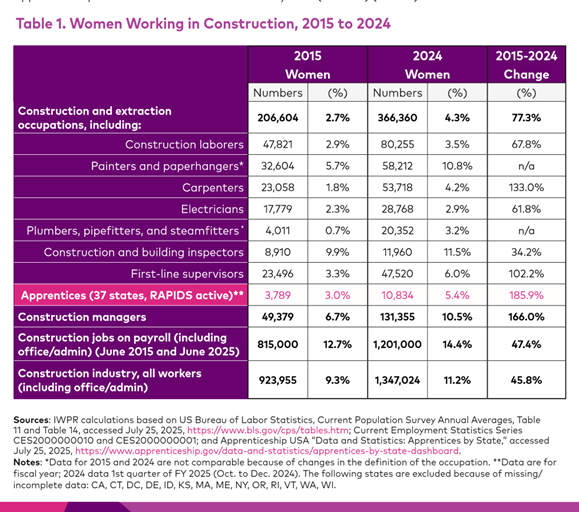
Women’s presence in construction apprenticeships has grown sharply over the past decade, but the trades still have a long way to go. Per the Institute for Women’s Policy Research, women hold just 5.4% of construction apprenticeships, and even smaller shares of the largest trades:

The following leaders have shown tremendous bipartisan spirit and good work this week, from Hill staff to heads of state to the storytellers shining a light on America’s workforce:

On May 2, 1783, Military Engineer and Architect Pierre Charles L'Enfant was promoted by brevet to Major of Engineers in recognition of his service to American liberty. In solidarity, Pierre changed his name to Peter when he arrived to fight for the thirteen colonies in 1777. We can be sure that Pierre/Peter would have been a very enthusiastic supporter of the American Apprenticeship Act.
And for those still under a "royal spell," today Princess Charlotte of Wales turns 11 years old.
Be kind to one another.