
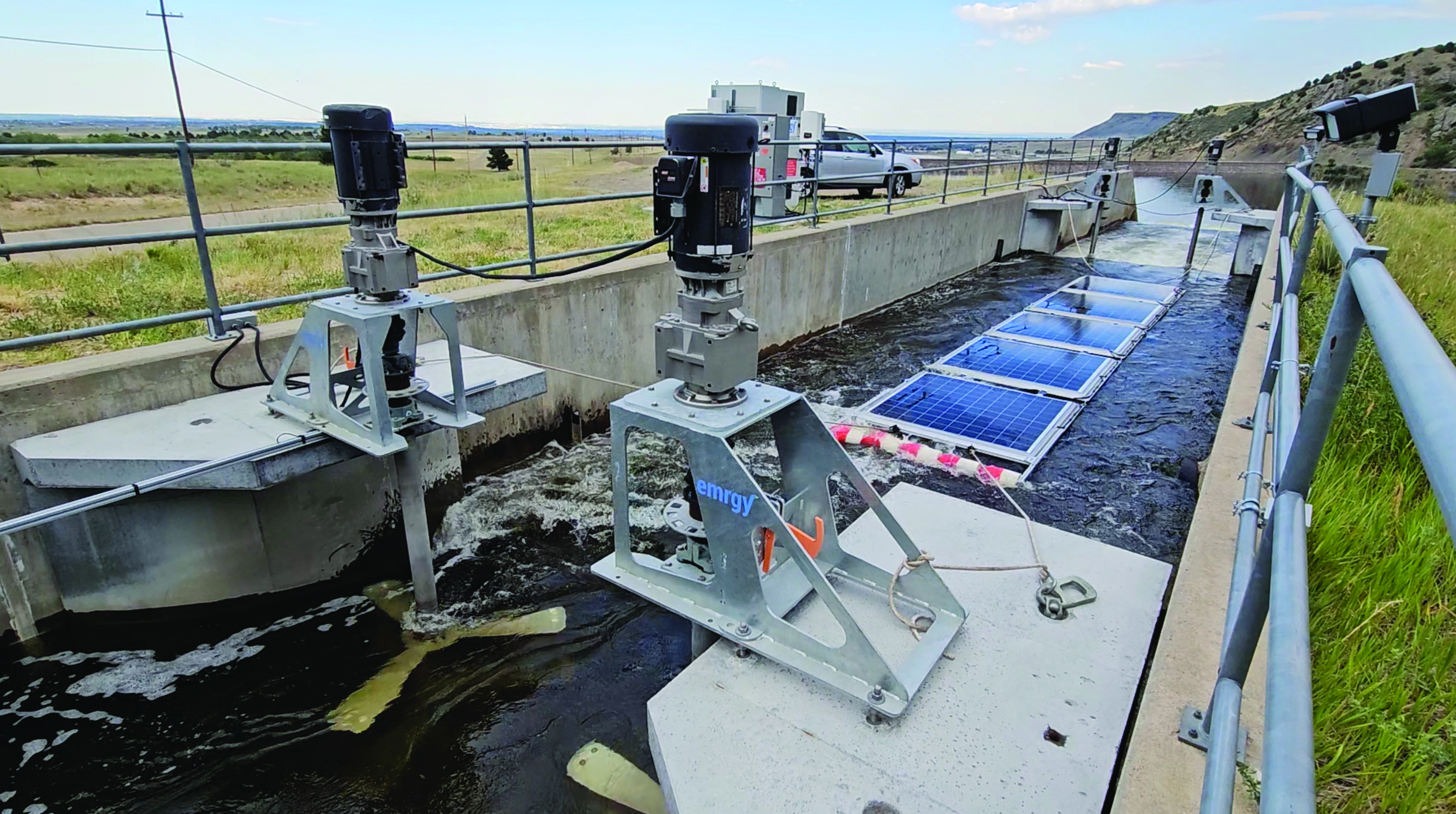
Top image: Emily Morris, founder and CEO of Emrgy, on-site at the Denver Water canal.
Emily Morris is the founder and CEO of Emrgy, an Atlanta hydropower company. Most hydropower in this country comes from massive dams built decades ago in remote canyons. Emrgy makes modular turbines small enough to drop into the irrigation canals, aqueducts, and water systems that already crisscross the American West. Infrastructure that water districts already own and operate becomes, with an Emrgy turbine in it, a source of clean, continuous electricity, generating power as a second job.
Emily was twenty-eight years old when her three-person company landed its first paying customer in Denver Water, the largest water utility in Colorado. The board had approved the purchase, and the turbine was due on site in six weeks. Emily did not yet have a built unit. She had drawings and prototypes. She would have to take a fifteen-thousand-pound custom machine from the drawing board to a flatbed truck in those six weeks, raise roughly a million dollars in capital because government utilities pay only after performance, and get married in the middle of all of it. On install day, Emily and her team drove behind the flatbed truck onto the canal site, hands out the window in excitement.
Long before that day, Emily was at a women’s networking event in Atlanta called Launchpad. She walked in not entirely sure what she was looking for. She walked out with two people.
The first was an attorney. When Emily described her idea, the attorney “grabbed me by the hand, metaphorically, and walked me through what a warrant was.” Emily, then in her mid-twenties, was thinking about spinning a piece of distributed hydropower technology out of her then-employer, an Atlanta engineering firm that had stopped investing in it. She did not have the cash to buy the technology outright. The attorney explained that a warrant would let her offer her employer a stake in a new company in exchange for the asset. They drafted a three-page document on the spot. Around the same time, an IP lawyer made Emily a different trade: he would teach her to draft her own provisional patents in exchange for one promise, that she would hire him when she got funded. He still represents Emrgy.
That was Emily’s first lesson in how the game is played. The rules are not always written down. Sometimes they are standing next to you at a networking event.
“Anytime you want to win a game, you have to know the rules, written and unwritten, and you have to maximize your position within those rules.” —Emily Morris
Emily set up an LLC online for one hundred and twenty dollars, “just to have an entity to actually talk about.” With that and the three-page warrant document, she walked into her employer’s office with a proposal. She would form a new entity, take on the technology, and offer the firm shares in a company that did not yet exist. As Emily tells it, the answer she got back was the same as the answer she went in with. Maybe the shares would be worth nothing. Maybe they would be worth gold. Let the business decide.
She did not quit her day job. From her desk at the engineering firm, she kept applying for federal energy grants under the new entity, Emrgy Hydro LLC. When the Department of Energy awarded Emrgy $1.25 million, she went full-time. She still calls herself “a fairly risk-averse person.” She has been taking real risks all along, just calculated ones, taken one step at a time.
She kept dialing. She called offices where, as she put it, “people had to answer my phone call.” One of those calls reached a city economic development office in Atlanta, where someone who had just been told to find ways to attract more entrepreneurs answered the phone. That conversation became Emrgy’s first municipal pilot, an unpaid demonstration of the company’s first turbine inside the city’s largest wastewater plant. Then came the call from Denver Water.
By the time Denver Water signed on, Emily had been planning her wedding for almost a full year. The wedding fell in the middle of the install crunch. She got married on schedule, left for her honeymoon in Japan, and stayed in the project from there. Somewhere over the Pacific, the thread between Emily and her small team back home kept getting longer. The lead times were impossible. The vendors had said no. The team’s read on the situation was that the only thing left to do was call Denver Water and tell them they weren’t going to meet the deadline.

Emily’s read was different, she wrote back: “We are doing it. There is no choice. There is no option.”
Denver Water had bet on her. Her team had bet on her. She had bet on herself (and her team). The install was going to happen.
She came home, got on another plane to a state she had never been to, and parked inside the manufacturing vendor’s facility until the parts came off the line.
Emily says it was the Denver Water team that got her there. They had hosted her for three days, walked her through their entire infrastructure, and stopped asking whether they should buy her equipment and started asking how many. They were betting on her, and she was not going to let them down.
Emrgy raised an $18 million Series A and is one of the rare hardware companies thriving in a climate-tech world otherwise built around software. Its turbines run from Georgia to Colorado, inside the infrastructure water districts and utilities already operate. By widely cited estimates, women-led companies receive less than three percent of venture capital in the United States. In energy, the share is likely smaller. Emily talks about that without grievance. That’s deliberate.

Cutaway view of Emrgy’s in-canal hydropower system at work. Water flows through the EMRGYFLUME ballast (1), an anchor-free concrete unit that sits on the channel floor and narrows the cross-section to accelerate the current. That faster flow spins the vertical-axis hydrokinetic turbines (2), each capable of generating up to 40 kilowatts at more than 70 percent water-to-wire efficiency. The permanent magnet generators above the waterline (3) convert the rotation into grid-ready, three-phase AC power.
Emily has spent a decade turning all of that into a competitive advantage. Some of Emrgy’s earliest fundraising momentum came from being the founder who did not look like the others in an investor’s portfolio, telling a story they had not heard before. In the agricultural water districts that buy her turbines, being a mother turned out to be a form of credibility rather than a liability. Her clients tell her not to fly out, to take the meeting on Zoom, to be home with her kids.
“My job,” she says, “is not to waste effort on complaining about the places the rules are unfair. The best way for me to influence those rules is to be successful inside the game I am playing.”
This May, she was in Washington, D.C., on the Hill as part of Intuit’s Small Business Council. She attended for the same reason she went to Launchpad, and to the city office that first took her call, and to the manufacturing floor in Wisconsin. Because being in the room is how the rules get shaped, and people who are not in the room do not shape them.
“There is nothing more fulfilling than being able to see people have their voices heard,” Emily says. “When you walk through the halls of the Capitol, especially if you do not live there, you feel the gravity of the transformational decisions that are made every day that affect every part of our lives.”
Emily is a working mom of a seven-year-old and a two-year-old and still happily married. She lives and is raising her young family in one of the most economically diverse corners of the country, where wealth and hardship share a ZIP code. She knows what it costs to raise a family while building a company. She also knows what people see when they see her: a young mother and a founder. Like all things, she does not treat that as a disadvantage. She treats it as an advantage. It is how she connects with people. It is how she builds. Her manner does not change from one room to the next. Once she knows the rules, she knows she can win.
She is still playing the game. She is also paying close attention to which rules she would like to rewrite.
Brendan Gleason is Engage’s Executive Director.