
Good morning, Thread Readers.
Ready or not, the transformational force of AI on the American workforce has arrived. Currently, the federal government does not have a credible, national, and public survey tracking how many American jobs AI has eliminated, created, or changed and the needed framework to collect this information moving forward.
Thankfully, Senator Josh Hawley (R-MO) and Senator Mark Warner (D-VA) are leading a bipartisan push to remedy this gap with the AI-Related Job Impacts Clarity Act (S. 3108). They have been joined by Senator Mark Kelly (D-AZ), Senator Jim Banks (R-IN), Senator Tim Kaine (D-VA), Senator Maggie Hassan (D-NH), Senator John Hickenlooper (D-CO), Senator Todd Young (R-IN), and Senator Mike Rounds (R-SD).
Engage suggests an opinion piece by Michael Steinberger that appeared this month in the New York Times. We raise our coffee cups to Mr. Steinberger for acknowledging the serious bipartisan work of Senators Hawley, Warner, and their colleagues in rectifying this gap in information.
Now let's dig in.

Women control more than $18 trillion in U.S. household financial assets, a figure projected to reach $34 trillion by 2030 (McKinsey, 2025). Women influence 70 to 80 percent of all consumer purchasing decisions (NielsenIQ, 2024). Women-owned small businesses are among the fastest growing segments of the U.S. economy, and a recent Goldman Sachs 10,000 Small Businesses Voices survey found that more than 75 percent of U.S. small businesses are now using AI, up from 60 percent just one year ago, yet only 14 percent have fully integrated it into core operations. Without reliable federal data on where AI is cutting jobs and where it is creating them, workforce training programs, education investments, and small business support are operating without a clear picture of what is happening on the ground.
New research underscores this risk. A March 2026 study by GovAI and the Brookings Institution, reported by Forbes, found that women hold an estimated 86 percent of the positions most exposed to AI and least adaptable to displacement. About 6.1 million clerical and administrative workers scored high on both AI exposure and low adaptability (Forbes). Researchers noted that workers in these roles often have limited decision-making power over how AI is used in their workplaces and face fewer exit opportunities if their jobs are eliminated.
Introduced in November 2025 by Senator Josh Hawley (R-MO) and Senator Mark Warner (D-VA), the AI-Related Job Impacts Clarity Act (S. 3108) would create the first federal reporting framework dedicated to tracking how AI affects American employment. The bill has been referred to the Senate HELP Committee (CNBC).
The AI-Related Job Impacts Clarity Act would:
• Require publicly traded companies and federal agencies to file quarterly reports with the Department of Labor on AI-related workforce changes, including layoffs, hiring, and retraining
• Give the Department of Labor authority, in consultation with the SEC and Treasury, to bring large private companies into the reporting framework based on workforce size, revenue, and industry impact
• Mandate that reports include the number of employees laid off, hired, or retrained due to AI adoption, changes in hiring practices, and unfilled positions linked to AI
• Direct the Department of Labor to aggregate employer disclosures and publish quarterly and annual public reports for Congress and the American people
• Protect proprietary business information and personal employee data within the reporting process
"Artificial intelligence is already replacing American workers, and experts project AI could drive unemployment up to 10-20% in the next five years. The American people need to have an accurate understanding of how AI is affecting our workforce, so we can ensure that AI works for the people, not the other way around."
— Sen. Josh Hawley (R-MO)
Building on the legislation, Senator Mark Kelly (D-AZ), Senator Mark Warner (D-VA), and Senator Josh Hawley (R-MO) led a bipartisan group of colleagues on March 5, 2026, in sending a letter to the Secretary of Labor, the Bureau of Labor Statistics, and the Census Bureau. The letter urges these agencies to prioritize the collection, analysis, and dissemination of high-quality, timely data on AI’s labor market impact. Joining Warner, Hawley, and Kelly in signing the letter were Senator Jim Banks (R-IN), Senator Tim Kaine (D-VA), Senator Maggie Hassan (D-NH), Senator John Hickenlooper (D-CO), Senator Todd Young (R-IN), and Senator Mike Rounds (R-SD).
The letter recommends specific changes to three federal surveys:
• The Current Population Survey (CPS), the backbone of the monthly jobs report, should add supplemental questions focused on AI and task-specific workforce changes
• The Job Openings and Labor Turnover Survey (JOLTS) should add questions on the occupations and wages of new hires and separations, and track how many hires, job postings, and layoffs are directly related to a business's use of AI
• The National Longitudinal Survey, which follows a sample of American youth, should include AI-related questions to track long-term career and wage effects
"Good policy starts with good data. This bipartisan legislation will finally give us a clear picture of AI's impact on the workforce, what jobs are being eliminated, which workers are being retrained, and where new opportunities are emerging. Armed with this information, we can make sure AI drives opportunity instead of leaving workers behind."
— Sen. Mark Warner (D-VA)
Facts Be Told
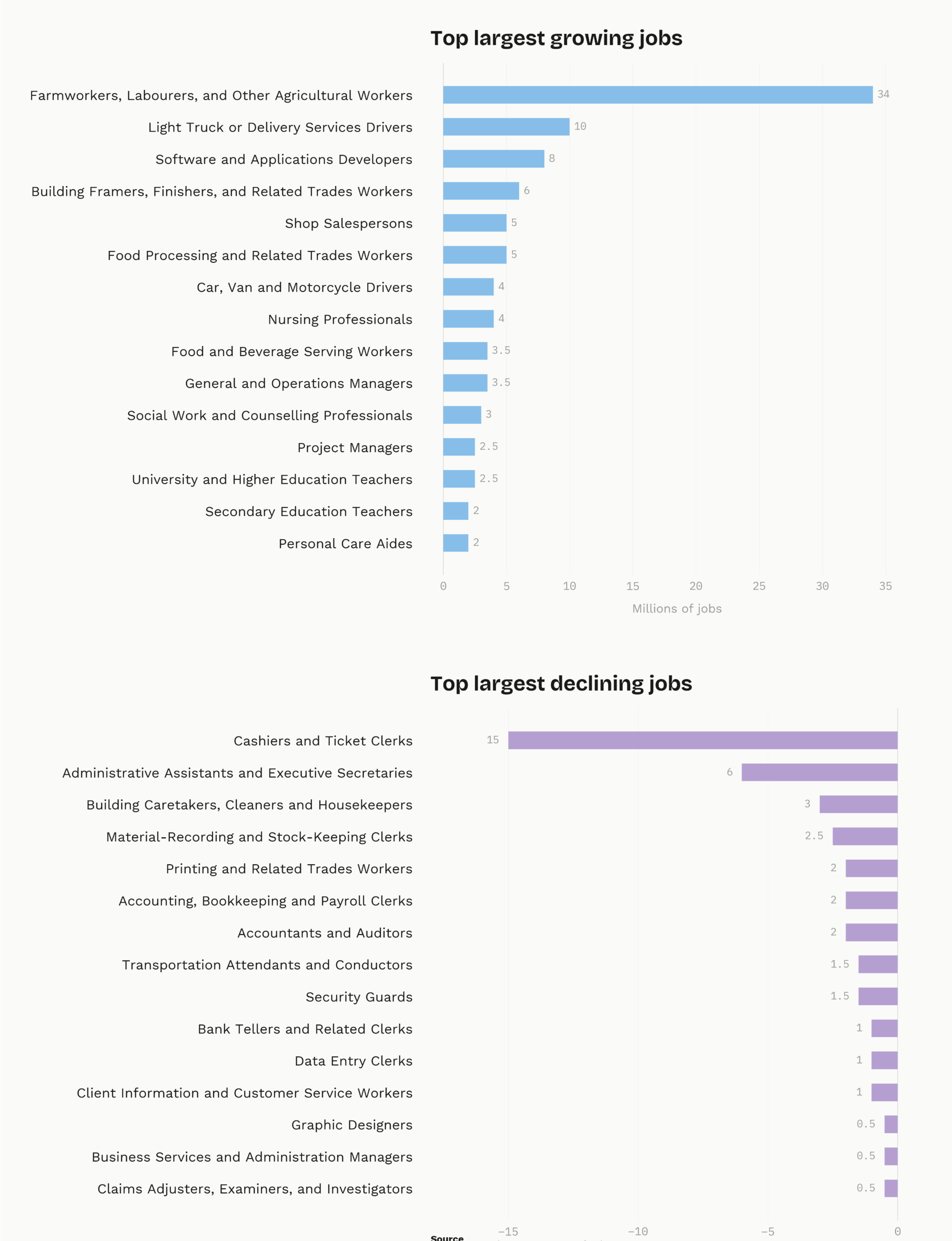
Studies on AI and the workforce do exist from sources like the World Economic Forum, the IMF, and private research firms, but these are global estimates, not U.S. government data built on what American companies are reporting quarter to quarter. That is the gap this legislation aims to close. Until it does, the best available picture comes from the World Economic Forum's Future of Jobs Report 2025:

The following leaders have shown tremendous bipartisan spirit in a commitment to women and families and inspired through their dedication, service, or art.

The statement Sen. Martin Heinrich, a Democratic Senator from New Mexico, released in advance of his vote supporting the newly-confirmed Secretary of Homeland Security, Markwayne Mullin, was extraordinary. It shouldn't feel extraordinary - but it does, precisely because it reflects a manner of respectful collegiality that used to be the norm.
People often treat bipartisanship as something nostalgic, a relic of a better era. But moments like this remind us it's not a memory, it can, and should, be our reality. All it takes is some leadership and gumption.
"This is going to surprise some people, but I consider Markwayne Mullin a friend. We have a very honest and constructive working relationship. We have authored legislation together, such as the Tribal Buffalo Management Act, and we crafted the Legislative Branch Appropriations bill together this year. We often disagree and when we do, we work to find whatever common ground we share."
— Sen. Martin Heinrich (D-NM)